
Less screen time. Better mood.
Ausklang helps you be more intentional with your phone and feel better afterwards. A quiet tool that gets softer over time — no streaks, no pressure.
Something we don't talk about enough
The pressure social media creates isn't your personal problem.
Comparing yourself until you feel smaller. Posting because you want others to see. Scrolling for hours without knowing why. That's not just "how things are". Those are real effects of platforms built to hold you longer — not to make you feel good.
Ausklang helps you notice where this happens to you. Not to cut social media out. To give you back the choice.
How Ausklang works
Four tools. No score, no streaks.
- 01 / 04
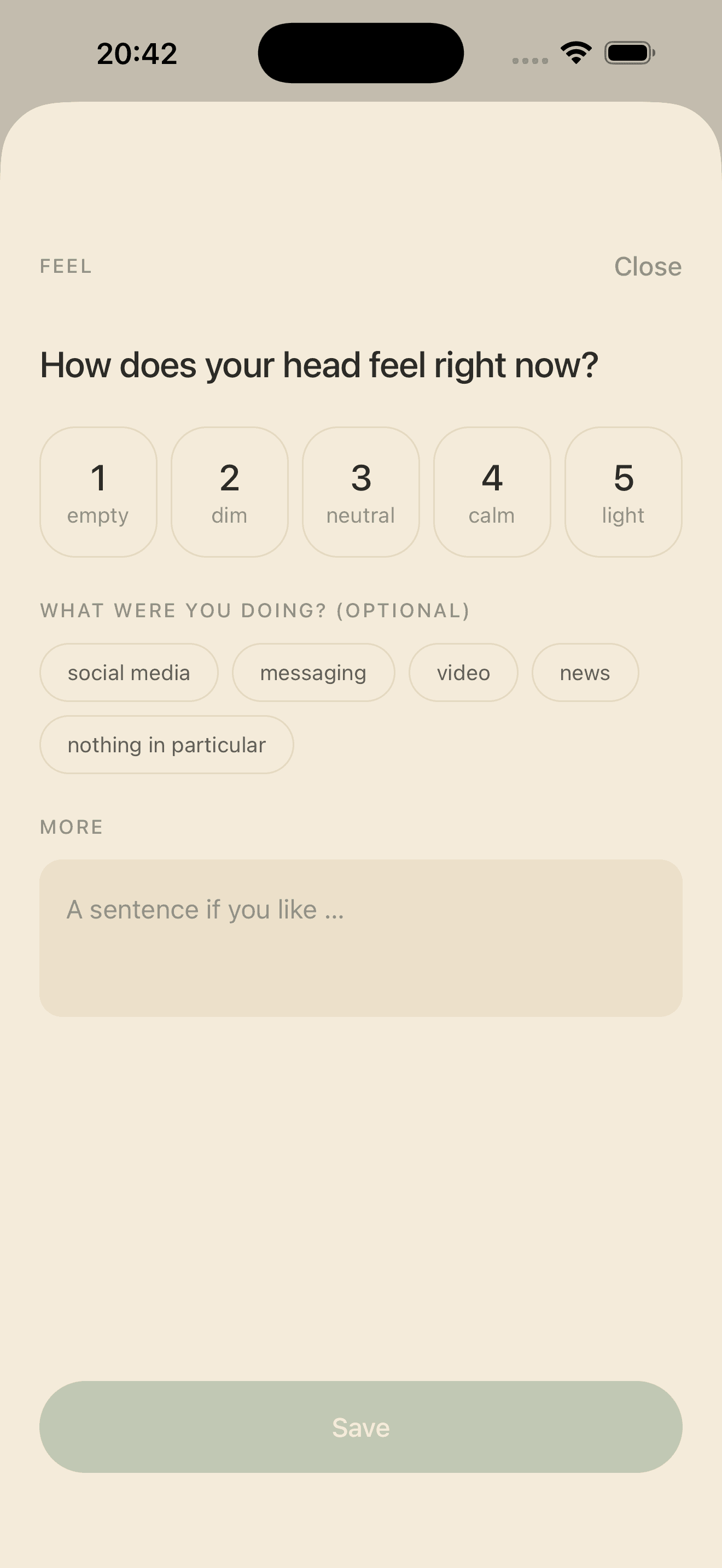
Log your mood
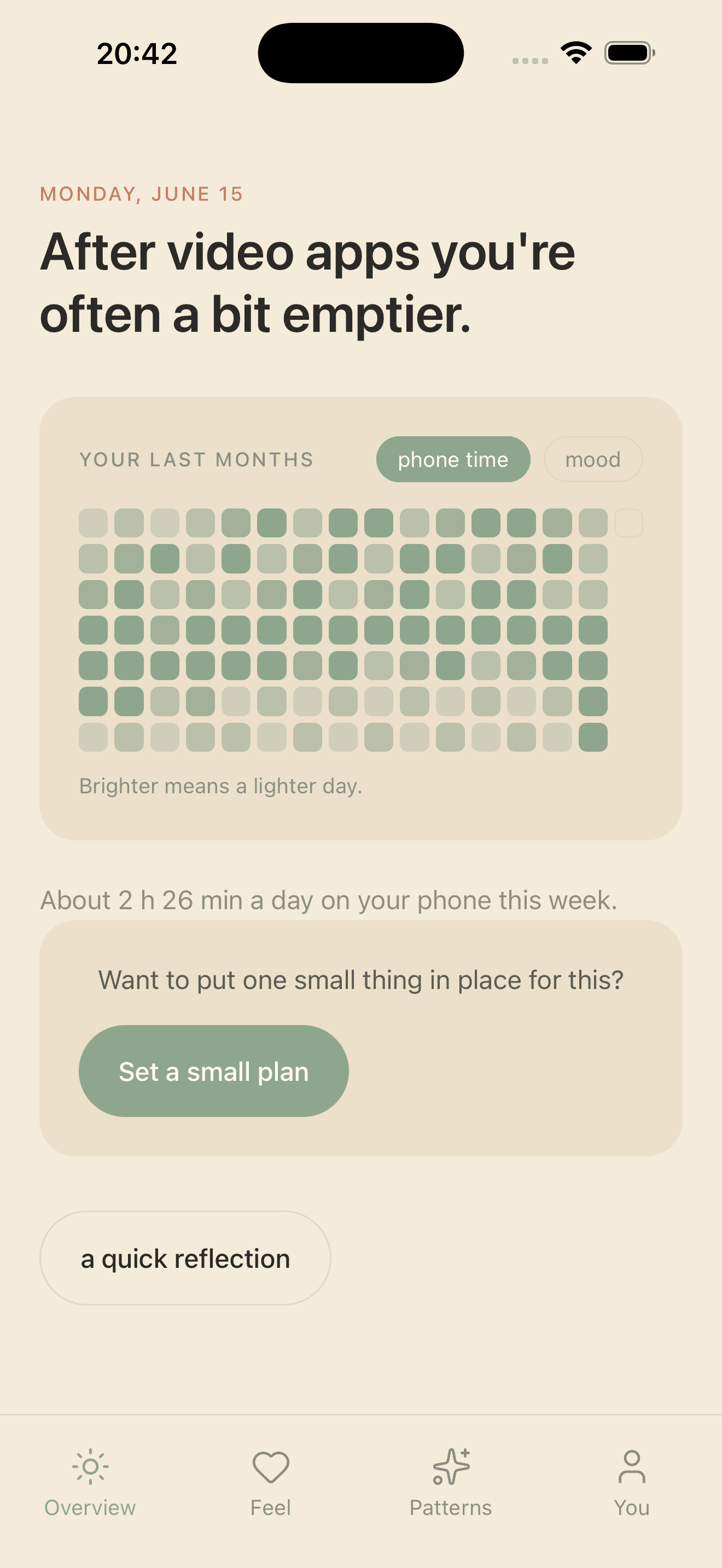
One tap captures how you feel after Instagram, TikTok, or WhatsApp. So you can see which apps lift you up — and which drain you.
- 02 / 04
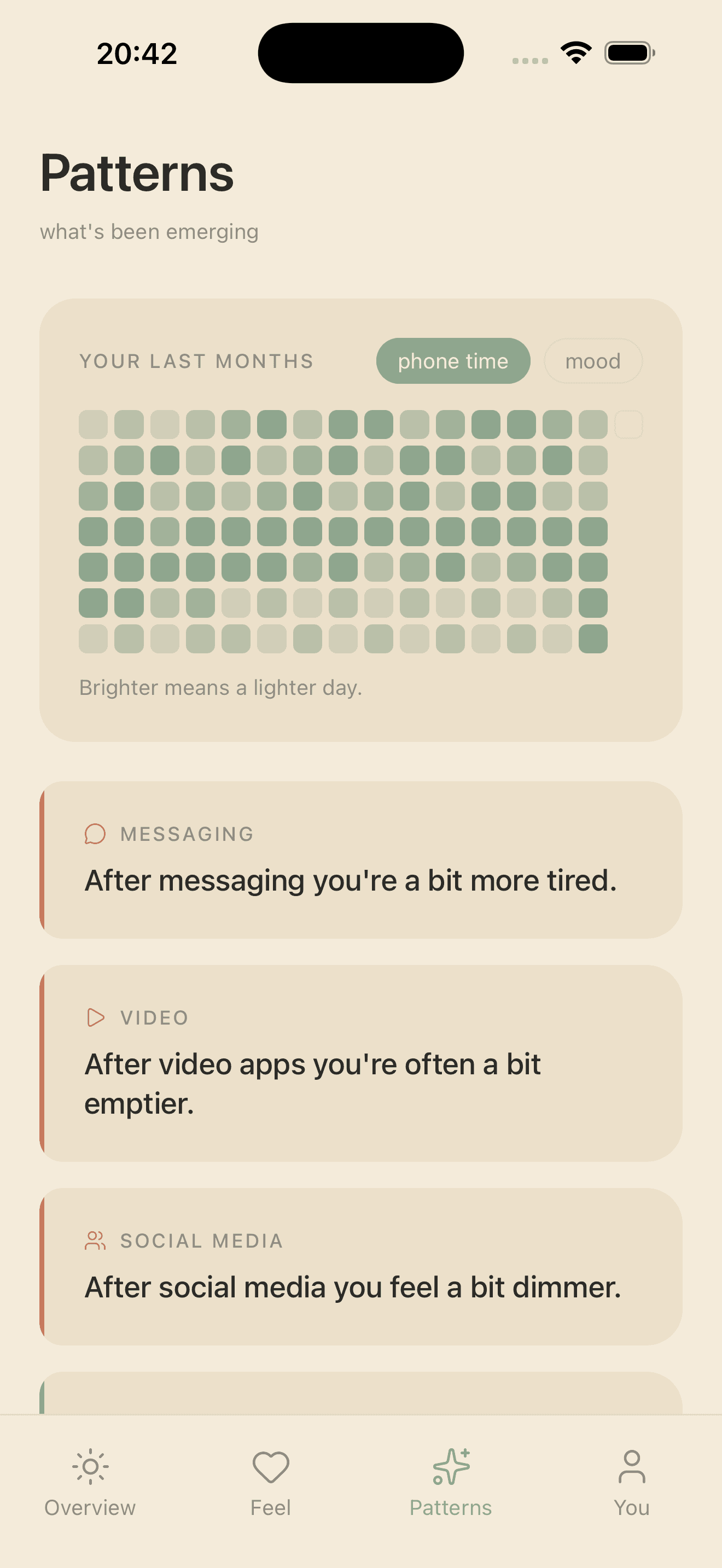
See your patterns
After a few days, Ausklang shows you your own patterns: when your phone gives you energy, when it takes it. In plain language — no score, no leaderboard.
- 03 / 04
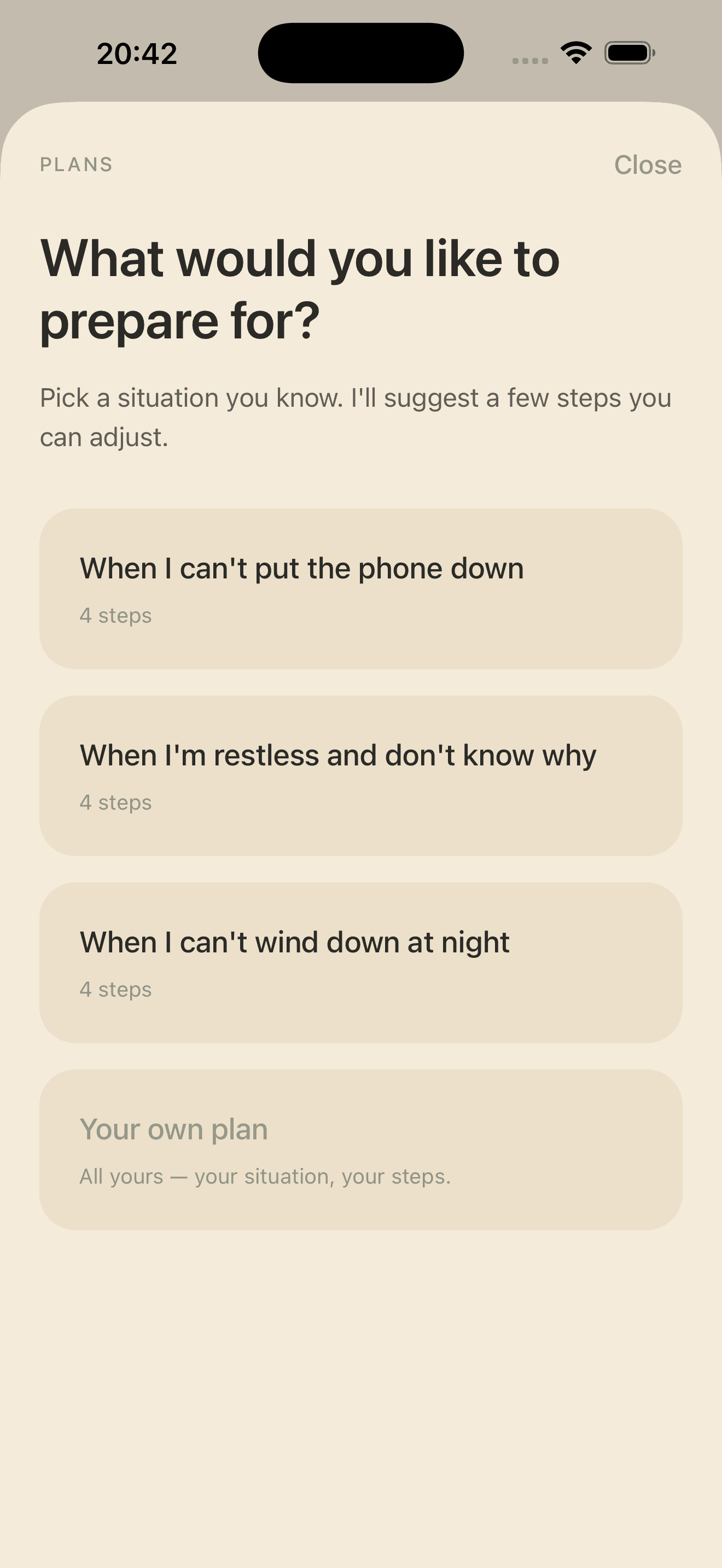
Plans for hard moments
Write yourself a plan for the moments when you usually scroll for hours. When it arrives, the plan is there — your calmer self helping your tense one.
- 04 / 04
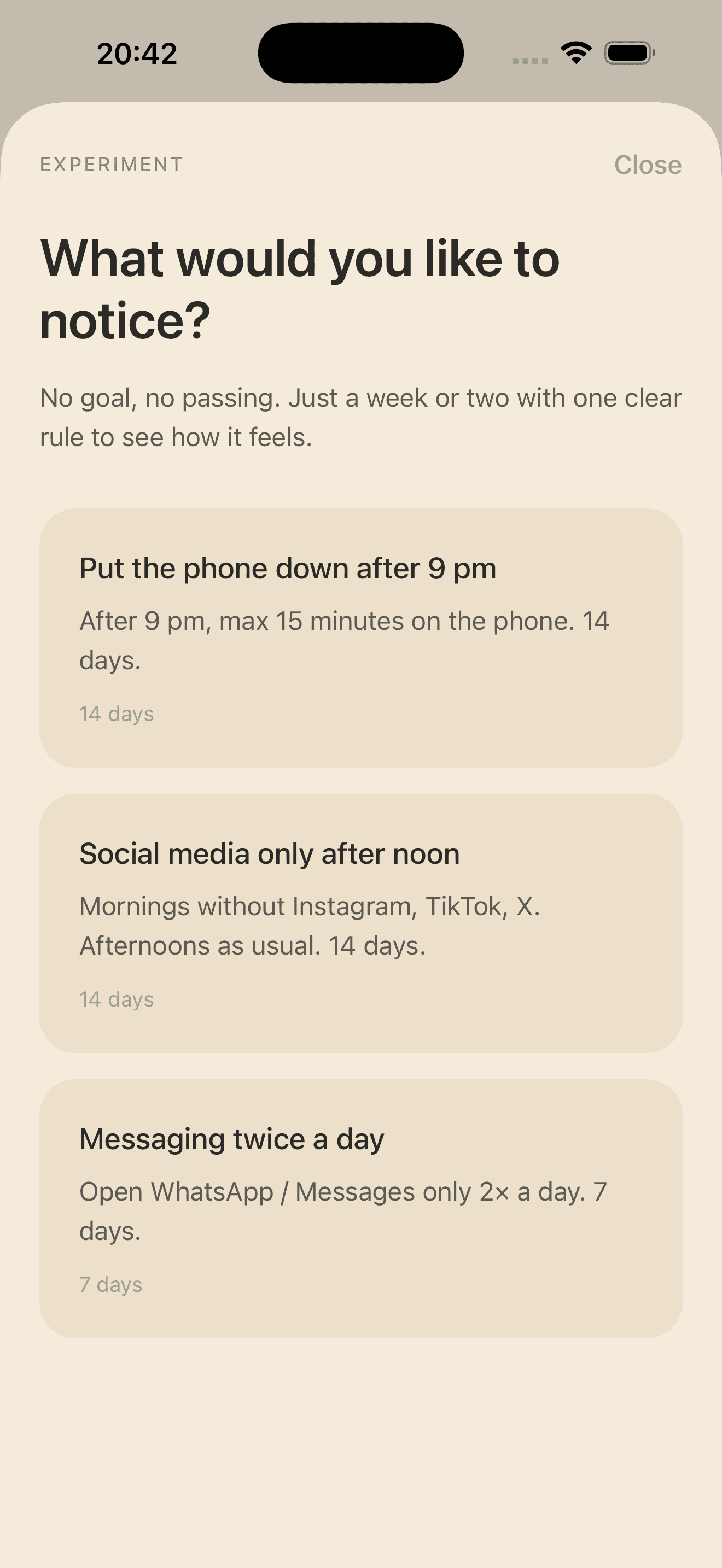
Small experiments
One rule, one to two weeks: no social before noon. Phone down after 9pm. No streaks, no passing — just you and the question of whether it helps.
Plus
Weekly digest — a quiet Sunday look at your week.
One page once a week: your mood patterns, what stood out, nothing that buzzes your phone.
The moment that matters
Not a gate before every app. A moment that fits.
Most tools in this category do the same thing on every launch: a pause, a counter, a lock. Predictable — and predictable means invisible within two weeks. Ausklang's interruption arrives when it fits you, and it brings something with it.
A measured number
“You’ve been here 47 minutes.” If nothing was measured, no number appears. A placeholder would be fiction.
A check now, not tonight
How does this feel right now? Sampling in the moment bypasses recall bias — and it’s what makes the later patterns worth anything.
Only learned observations
“After social you feel slightly dimmer” appears only once it came from your data. Guesses stay guesses.
Your plan for this exact trigger
Not a generic tip — your own if-then sentence. The mechanic with the strongest evidence in the category (d ≈ .65).
Alternatives pointing outward
The prompt points into your actual life, not deeper into the app.
Three ways out, all equal
Start the plan, put the phone down, keep going. “Keep going” is always there and costs nothing. No guilt copy, no counter.
You've been here for 47 minutes.
How does this feel right now?
After social media you often feel a bit dimmer.
Your plan
When I'm scrolling in bed at night, I put the phone on the desk and read three pages.
And the app learns whether it reaches you at all.
Engage and the daily budget rises — to at most six. Dismiss and it falls — to one. At least 90 minutes apart, nothing between 22:00 and 07:00. Across five presence phases the ceiling itself drops: from day 181, at most one a day. The app is built to remove itself.
At the start
up to 6 a day
From day 181
at most 1 a day
A promise
Your data stays on your device.
Ausklang has no servers that see your entries. If you want to sync between your devices, it goes through your iCloud or Google Drive — never through us.
Ausklang can only see what you grant through Apple's Screen Time (iOS) or Android's Digital Wellbeing. The permissions are controlled by the operating system — not by us.
- No accounts, no logins
- No trackers, no analytics
- Measurement only via iOS/Android permissions
- Works offline
This is how Ausklang looks on your phone.
Overview, Mood, Patterns, Experiments — everything you need, nothing you don't.
Overview 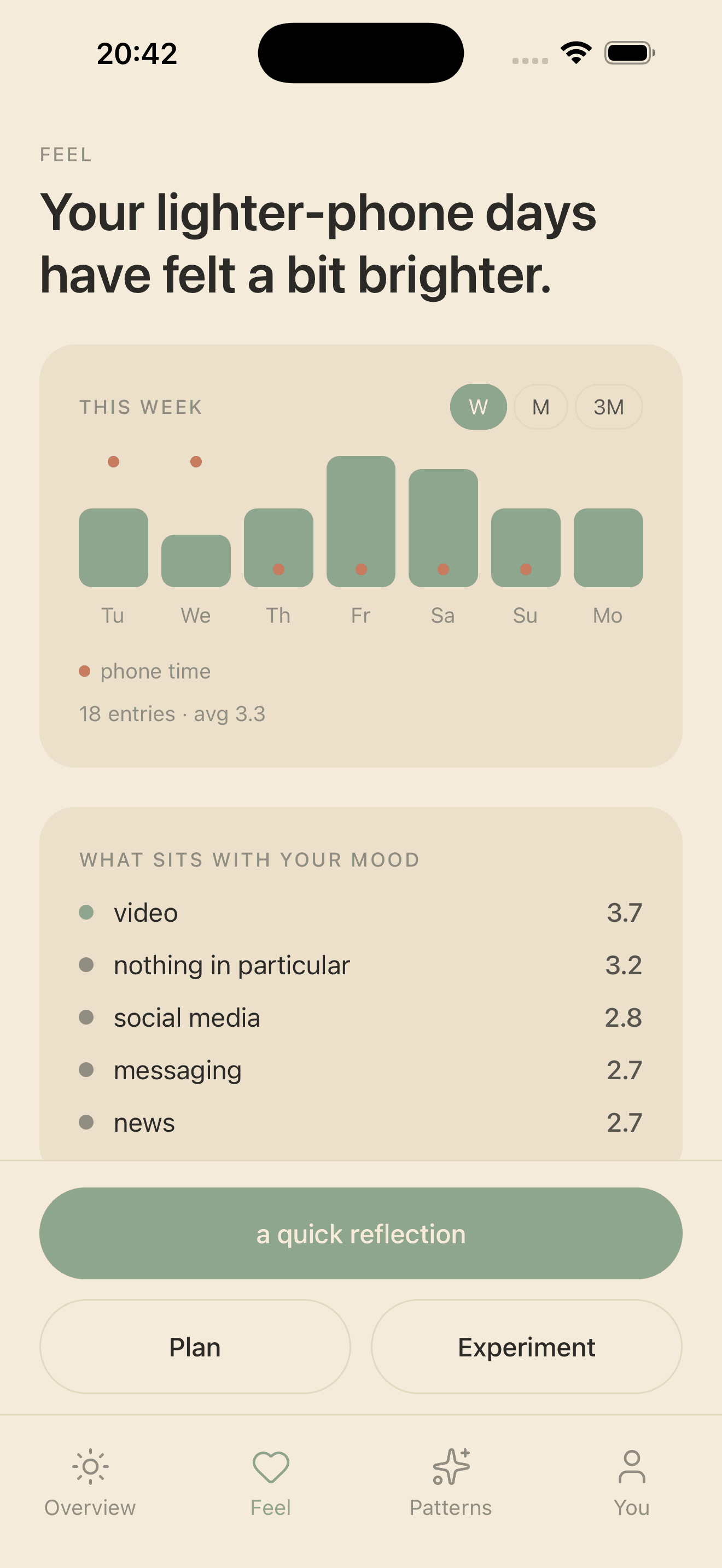
Mood across the week Patterns 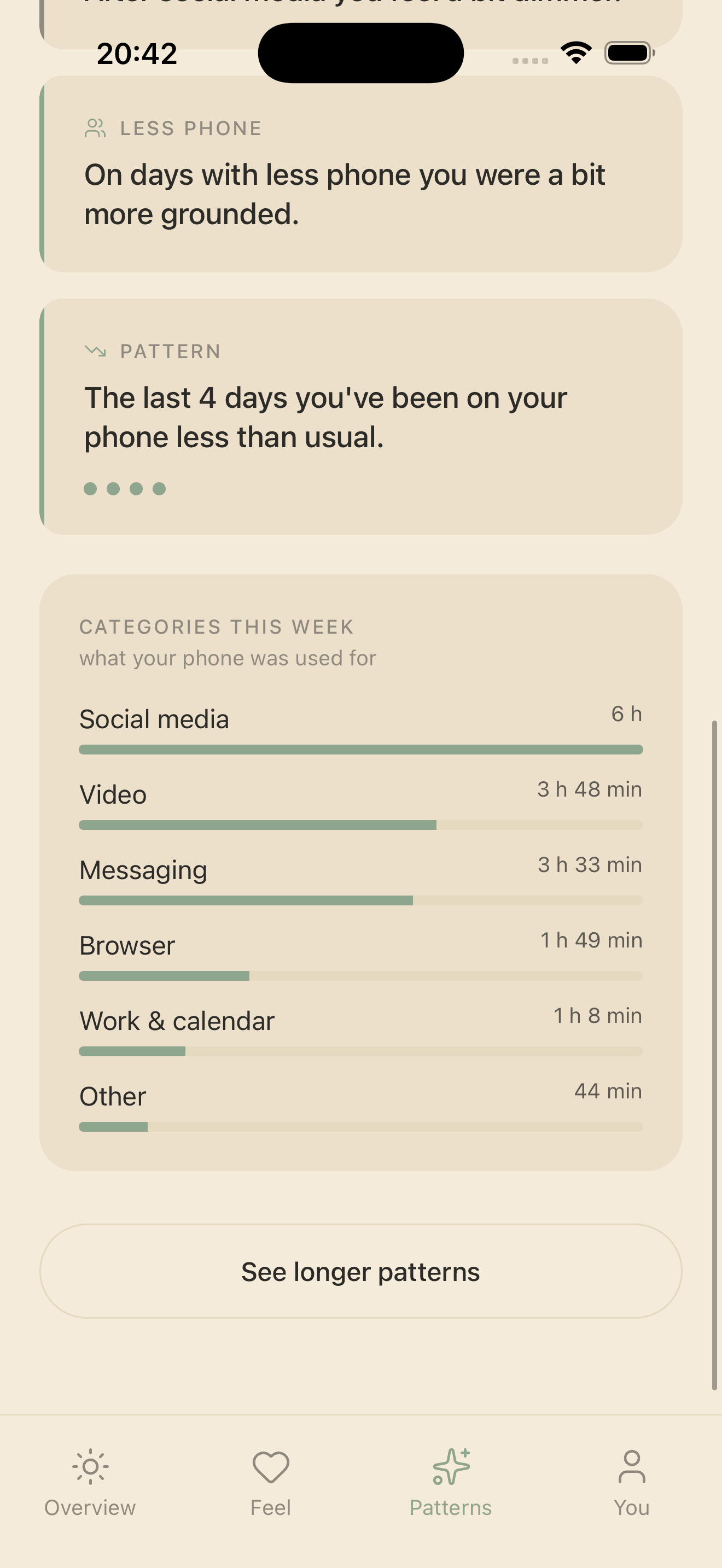
What the phone was used for Plans for hard moments Small experiments Mood check
What Ausklang is
A tool. Not a therapy.
Ausklang helps you reflect on your relationship with your phone and try out small behavioural changes. That's it — nothing more, nothing less. No diagnosis, no treatment, no replacement for therapy. We won't pretend to be something we're not.
How we think about AusklangWho's behind it
One person, one degree, no investors.
Ausklang is built by Jonas Höttler in Munich. He holds an M.Sc. in Digital Psychology — the same research the app stands on. There's no team, no growth targets, no investors who were promised usage time. That's the reason an app designed to be used less can exist at all.
- No investors, no usage targets, no advertising
- No subscription — €39.99 once, or use it free
- No analytics SDK, no crash reporter, no tracker in the app
- A human answers the mail: contact@balane.tech
Topics
What people are actually looking for.
A few rooms where we've thought for a while — in case one of the questions is yours.
Phone addiction: a more honest word — and what actually moves
A more honest word — and what actually moves.
Screen time: why counting hours rarely helps — and the better question
Why counting hours rarely helps — the better question.
Digital Detox Without the Lockouts
Why time-based abstinence rarely sticks.
Dopamine Detox, Honestly: What Works and What's a Myth
What's true about dopamine detox — and what isn't.
Dumb Phone Curious? A Calmer Middle Path
Less phone without buying a dumb phone.
The method behind Ausklang — why app blockers fail and what works instead
The evidence behind the app — with sources.
How to stop doom-scrolling — without hating your phone
How to actually stop — without hating your phone.
Why habit trackers backfire — and the quieter alternative
Why streaks often backfire — the quieter way.
One Sec alternatives 2026 — 5 apps that observe instead of brake
Five apps that observe instead of brake.
Opal app alternatives 2026 — five quieter screen-time apps
When the blocker is more fight than help.
Phone anxiety is real. Here's a gentler way to look at it.
A gentler look — not therapy, not diagnosis.
FAQ
Questions that come up.
Is this a meditation app?
No. Ausklang doesn't meditate with you. It helps you see how your phone affects your mood — and gives you a small plan for hard moments.
What does Ausklang cost?
The app is free to use. If you want to look deeper into your patterns (30 / 90 / 365 days, per app, export), a one-time unlock is available. No subscriptions.
Do you silently track my screen time?
No. Ausklang only sees what you enter yourself, plus — if you allow it — anonymised hints about session length. Nothing leaves your device.
Are there push notifications?
At most three a day, silent at night. Only if you allow them. They get softer over time, not louder.
Which devices?
iPhone and iPad (iOS), plus Android phones and tablets. There's no web version — Ausklang runs entirely on your device.
Which language?
German and English, automatically from your system language.
How does Ausklang measure my usage?
Through your device's official APIs: Apple's Screen Time on iOS/iPadOS, Digital Wellbeing on Android. You decide in system settings what Ausklang can see — and what it can't. We can't read anything the OS doesn't grant.
I can't afford the unlock right now.
Then write us. Every month we keep a small quota of free codes for people whose money is tight — no proof, no justification. Your own honest estimate is enough.
How it worksAusklang
If you want it quiet.
Download Ausklang. Two weeks is a good start.